The Best Open Source Dictation Software in 2026
Twelve open-source speech-to-text tools compared by licence, engine, and platform - including which projects are actually maintained.
Written by Dictation Database Team
Open-source dictation went from a curiosity to a real option the moment Whisper was released under a permissive licence. Anyone could now build a dictation app around a model that was competitive with the commercial engines, and a lot of people did. The category is now crowded enough that the useful question isn't "does one exist" but "which one is maintained."
Short answer: Handy is the best all-round open-source dictation app, Buzz is the best for transcribing files, Vocalinux is the best on Linux, and VoiceInk is GPL v3 despite selling a $29 binary.
The projects
| Tool | Licence | Platforms | Engine | Maturity |
|---|---|---|---|---|
| Buzz | MIT | macOS, Windows, Linux | Whisper + HF models | ~20,900 stars |
| Vibe | MIT | macOS, Windows, Linux | Whisper, Parakeet, Nemotron | ~7,000 stars |
| nerd-dictation | GPL-3.0 | Linux | VOSK | ~1,900 stars |
| Amical | MIT | macOS, Windows | Whisper + Ollama | ~1,500 stars |
| Vocalinux | AGPL-3.0 | Linux | whisper.cpp, VOSK | ~728 stars |
| Dragonfly | LGPL-3.0 | Windows, macOS, Linux (X11) | Multiple | ~416 stars |
| Caster | GNU | Windows, Linux (X11) | Dragon, Kaldi, WSR | ~357 stars |
| OpenTypeless | Open source | macOS, Windows, Linux | BYOK, many | ~440 stars |
| VOXD | MIT | Linux | whisper.cpp | ~288 stars |
| Handy | MIT | macOS, Windows, Linux | Whisper, Parakeet | Actively developed |
| Whispering | AGPL-3.0 | Browser, desktop | Local GGUF or BYOK | Part of Epicenter |
| OpenWhispr | MIT | macOS, Windows, Linux | Whisper, Parakeet, BYOK | Actively developed |
| VoiceInk | GPL-3.0 | macOS (Apple Silicon) | Local | $29 binary, free source |
| Serenade | Open source | macOS, Windows, Linux | Local or cloud | Original unmaintained |
| Numen | Libre | Linux |
Browse them all in the open-source collection.
Best all-round: Handy
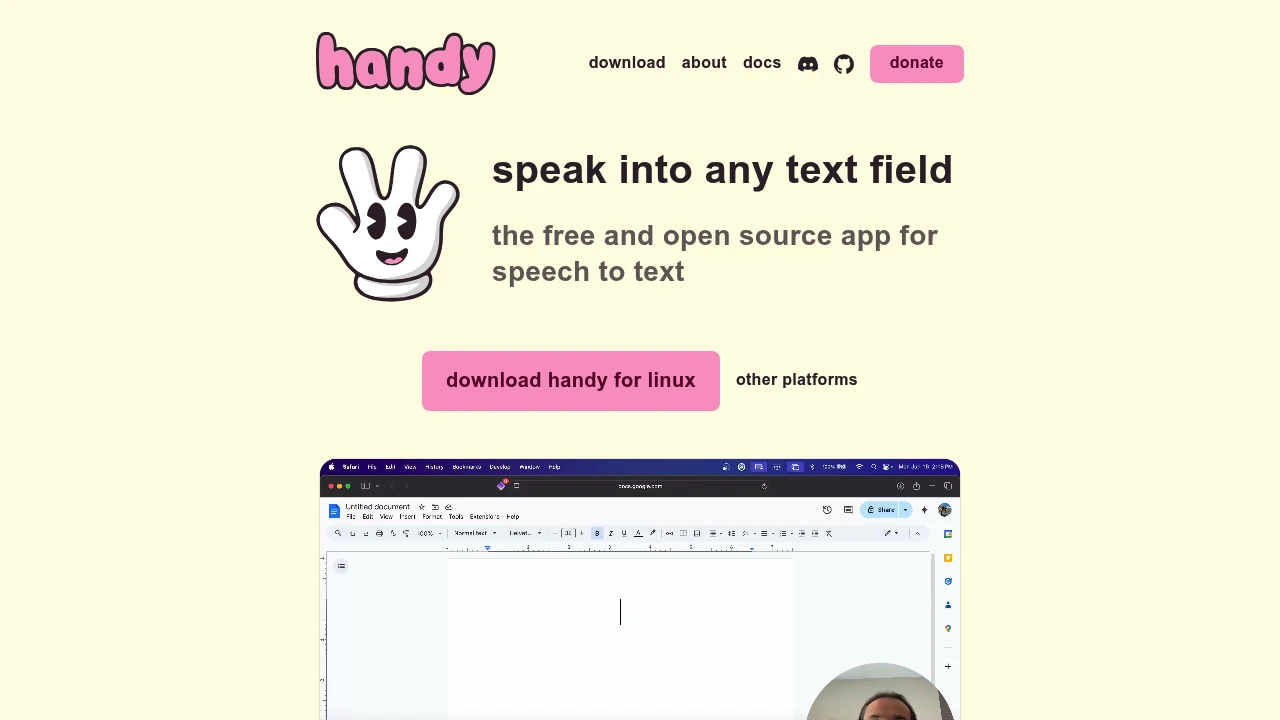
Handy is MIT-licensed, ships real builds for macOS (Intel and Apple Silicon), Windows x64, and Linux x64, and makes no network calls at all. It runs Whisper Small, Medium, Turbo, and Large with GPU acceleration, plus Parakeet V3 and custom GGML models, and exposes CLI parameters so you can drive it from scripts. There's a Raycast extension too.
The reason to pick it over the alternatives is that it's a finished application rather than a project you assemble. Install it, pick a model, set a hotkey, done.
Best for files: Buzz
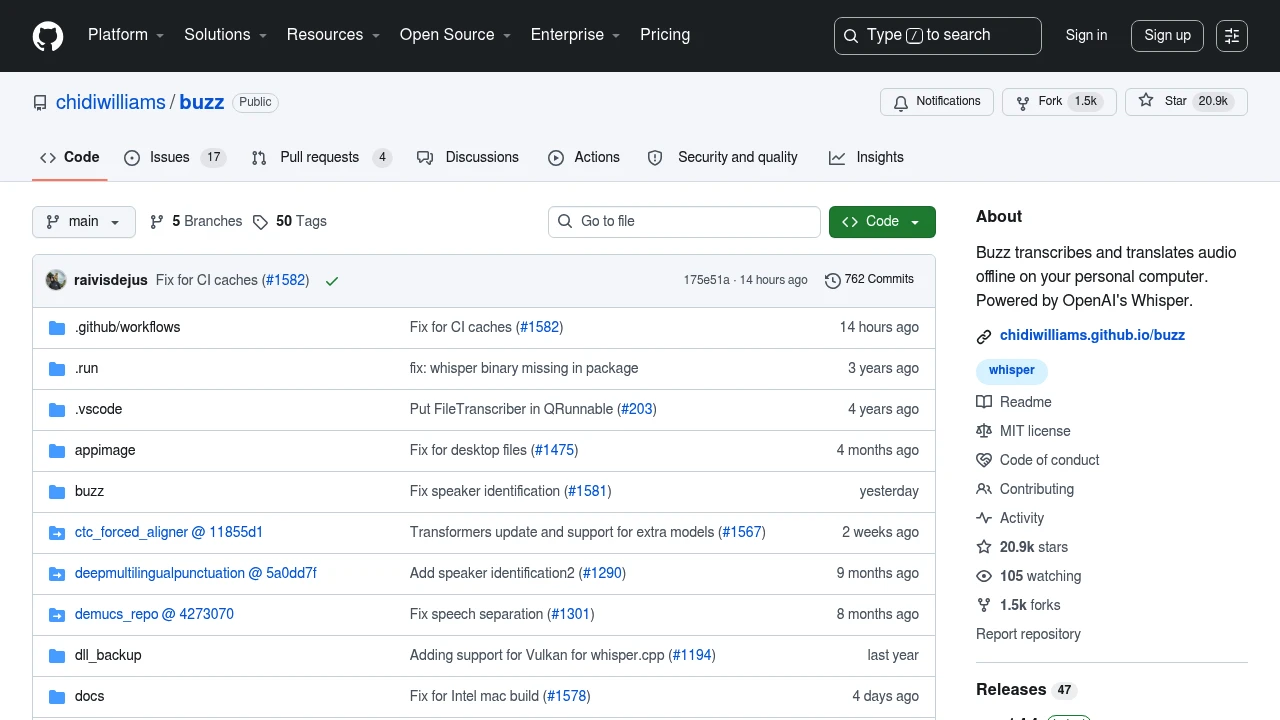
Buzz is the most-starred project in this category at around 20,900 stars, with 1,500 forks and active maintenance. It handles audio files, video files, YouTube links, and live microphone input, and accelerates on CUDA, Apple Silicon, and Vulkan. It installs via Flatpak, Snap, or PyPI, and supports Hugging Face Transformer models of Whisper type alongside OpenAI's own.
Vibe is the one to use instead if you need speaker diarization, batch processing, or exports to SRT, VTT, TXT, HTML, PDF, JSON, and DOCX. It also supports Nemotron 3.5 and Parakeet TDT v3 alongside Whisper, with GPU optimisation for NVIDIA, AMD, and Intel.
Fully local, including cleanup: Amical
Most local dictation tools transcribe and stop. The cleanup that makes cloud dictation feel polished - removing filler words, fixing false starts, formatting for the app you're in - normally requires a language model, and that normally means a cloud call.
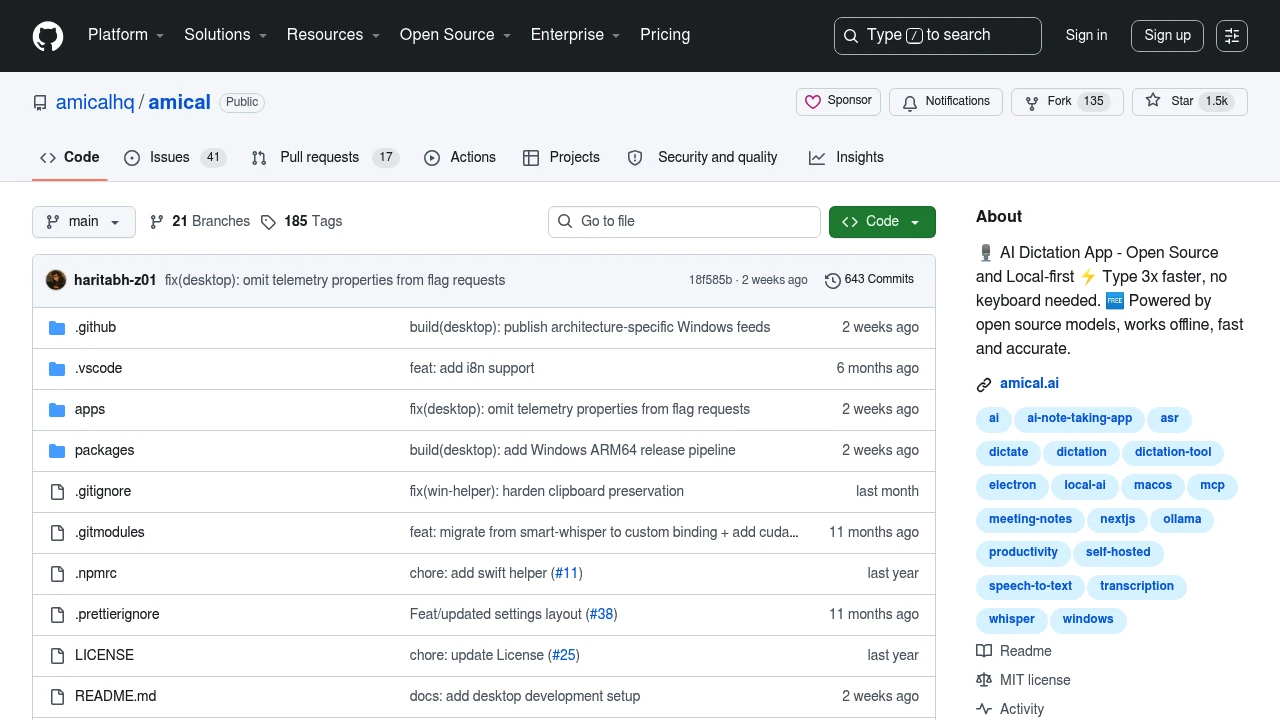
Amical does it locally: Whisper for speech, Ollama for text cleanup, both on your machine. MIT-licensed, macOS and Windows, with Linux planned, iOS in beta, and an Android build on Google Play. Around 1,500 stars and 643 commits.
The cost is resources. You're running two models at once, so this wants a machine with headroom.
Bring your own keys: OpenTypeless and Whispering
Two projects take a different approach: the app is free and open, and you supply API keys for whichever models you want.
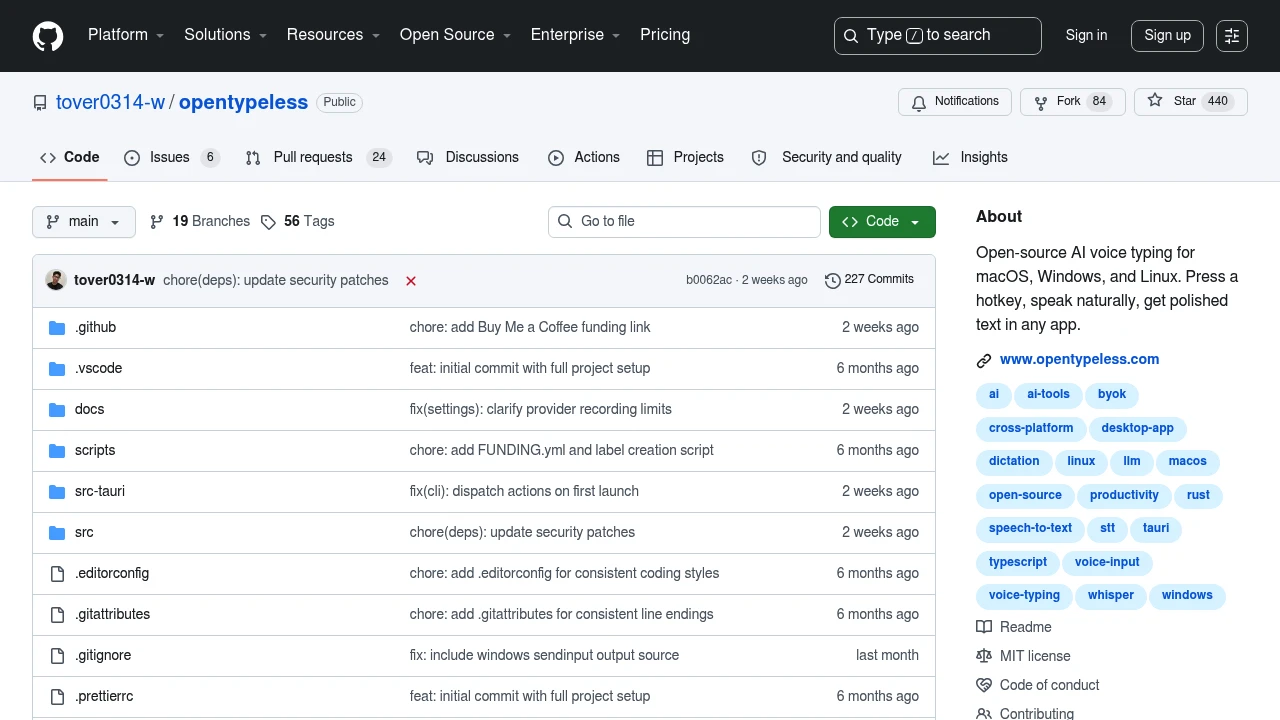
OpenTypeless lets you mix any speech model with any cleanup model - Groq Whisper, OpenAI Whisper, Deepgram, AssemblyAI, or Apple Speech on macOS for transcription; OpenAI, DeepSeek, Claude via OpenRouter, Gemini, Groq, Qwen, or Ollama for cleanup. Note that most of those configurations are cloud calls, so this is only offline if you pair Apple Speech with a local Ollama model.
Whispering is now part of Epicenter and runs in the browser or as a Tauri desktop app on all three platforms, with local GGUF models on desktop and self-hosted endpoints if you'd rather run your own inference server. AGPL-3.0 for the apps, MIT for the developer toolkit.
Both are good picks if you already pay for API access and object to paying a second subscription for a wrapper around it.
The voice coding stack
Voice coding is almost entirely open source, and almost entirely built on one non-open foundation.
Talon Voice is free to download but not open source itself - it's the engine most of the ecosystem sits on. Cursorless is an open-source Talon extension for VS Code that puts coloured "hats" on every token so you can address any of them in a single command. Dragonfly is LGPL-3.0 and lets one Python grammar drive Dragon NaturallySpeaking, Windows Speech Recognition, Kaldi, or CMU Pocket Sphinx; install dragonfly2 from PyPI, which is the maintained fork. Caster is a ready-made Dragonfly command set covering 13+ programming languages.
Serenade deserves a warning: it's the friendliest of these to learn, but the original project is unmaintained and development has moved to a community fork with a beta release. Check the fork's activity before you build a workflow on it. More in the best voice coding tools.
Checking whether a project is alive
Star counts are lagging indicators. Before committing:
- Recent commits, not total commits. Caster has 2,225 commits and 65 open issues; look at the last six months, not the lifetime.
- Releases. Vocalinux shipped v0.15.0 recently. OpenTypeless is on v1.1.49 and shipping regularly.
- Who's behind it. A single maintainer is a real risk, and most of these are single-maintainer projects.
- Whether the fork is the real project. Serenade and Dragonfly both have this pattern - the canonical name points at a dead repo.
Licence, briefly
If you only intend to use these tools, any of these licences is fine. If you plan to build on them:
- MIT (Handy, Buzz, Vibe, Amical, OpenWhispr, VOXD) - do essentially anything.
- GPL-3.0 (VoiceInk, nerd-dictation) - derivatives must be GPL too.
- AGPL-3.0 (Vocalinux, Whispering) - the network clause means running a modified version as a service triggers the copyleft.
- LGPL-3.0 (Dragonfly) - link against it without relicensing your own code.
Frequently asked questions
What is the best open source dictation software?
Handy for dictating at the cursor on any desktop OS, Buzz for transcribing files, Vocalinux on Linux, and Amical if you want local AI cleanup as well as transcription.
Is open source dictation as accurate as paid software?
For raw transcription, yes - these tools run the same Whisper and Parakeet models. The gap is in polish: custom vocabulary management, per-app formatting, and speech cleanup. Amical closes most of that gap locally.
Is Whisper itself open source?
The models and inference code are released under the MIT licence, which is why so much of this category exists. whisper.cpp, the C++ port used by Vocalinux and VOXD, is also MIT.
Can I use open source dictation offline?
Most of it, yes - Handy, Buzz, Vibe, Amical, Vocalinux, nerd-dictation, and VOXD all run locally. OpenTypeless is the exception: most of its configurations are cloud calls.
Is Talon Voice open source?
No. Talon itself is free to download but proprietary, with a Patreon tier for early access. The ecosystem built on top of it - Cursorless and most community configs - is open source.
Last verified: 10 August 2026.